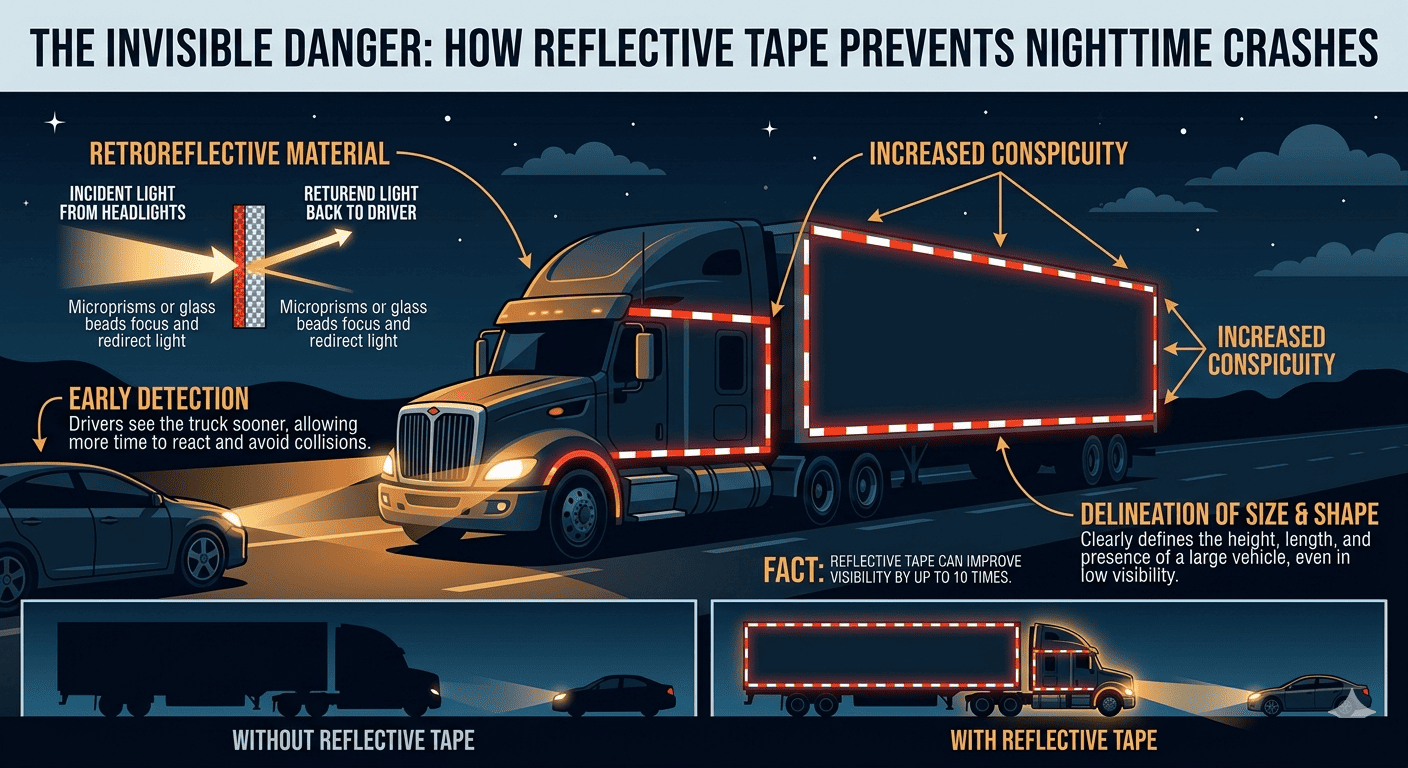
The Invisible Danger: How Reflective Tape Prevents Nighttime Crashes
Reflective tape, also referred to as conspicuity tape or vehicle-marking tape, is vital for vehicle and road safety. Its highly reflective properties are engineered to significantly enhance the visibility and contour recognition of all types of vehicles through retroreflection, especially in low-light conditions or adverse weather. By doing so, it effectively reduces the risk of rear-end collisions and other accidents. This crucial safety feature plays a role similar to road traffic signs, helping to prevent traffic accidents and encouraging compliance with traffic safety regulations.
The history of reflective material dates back to 1933, when Percy Shaw, a British engineer, witnessed the natural reflection of a cat’s eyes reflecting his car headlights. This insightful observation led to a groundbreaking invention: applying retroreflection to road infrastructure. In 1937, the manufacturer 3M created the world’s very first glass-bead reflective tape. Nearly three decades later, in the 1960s, Reflexite of the USA (which later merged with Orafol) pioneered micro-prismatic reflective technology. Since these two breakthrough innovations, the reflective sheeting materials industry has enjoyed rapid growth within the global road safety sector—a trajectory that continues steadily today.
Reflective tape plays a critical role in enhancing road and vehicle safety, particularly during nighttime driving or in low-visibility weather conditions. Because retroreflective material reflects light directly back toward its source, it significantly increases the visibility of vehicles to surrounding drivers. Whether a vehicle is large or small, reflective tape substantially minimizes the risk of collisions, ensuring the protection of drivers, passengers, and pedestrian road users alike.
The following points outline why high-quality retroreflective tape is essential for vehicle and road safety, along with key performance insights to consider for maximum benefit:
1. Enhanced Visibility in Low-Light Conditions
The most significant advantage of reflective tape is its ability to improve visibility in darkness, heavy night conditions, or poor weather such as fog, rain, and snow. Following decades of technological evolution, modern reflective tapes utilize advanced retroreflective technology, which primarily falls into two categories: glass microbeads or micro-prismatic structures.
Reflective tape functions by bouncing light from an approaching vehicle's headlights directly back to the driver's eyes. This makes a vehicle clearly visible from a much further distance, allowing trailing drivers to detect its presence early and react safely. Numerous industrial studies and real-world statistics support this safety benefit. For large vehicles like commercial trucks and buses, which possess expansive blind spots, applying reflective tape to the sides and rear outlines their precise dimensions, successfully preventing sideswipe and rear-end collisions.
2. Prevention of Rear-End Collisions
Rear-end collisions represent a major percentage of global traffic accidents and are considered among the most common road hazards. These incidents frequently occur when a driver fails to notice a stationary or slow-moving vehicle ahead in time. This danger can be dramatically reduced by installing reflective strips on rear bumpers or tailgates to serve as an immediate visual warning. When illuminated by the headlights of an approaching car, this conspicuity tape returns the light directly to the source, alerting the trailing driver to maintain a safe stopping distance or reduce speed. While reflective material cannot guarantee immunity against all accidents, correctly installed and well-maintained reflective tape provides drivers with crucial extra split-seconds of reaction time, significantly lowering the probability of a severe impact.
3. Compliance with Traffic Regulations and Safety Standards
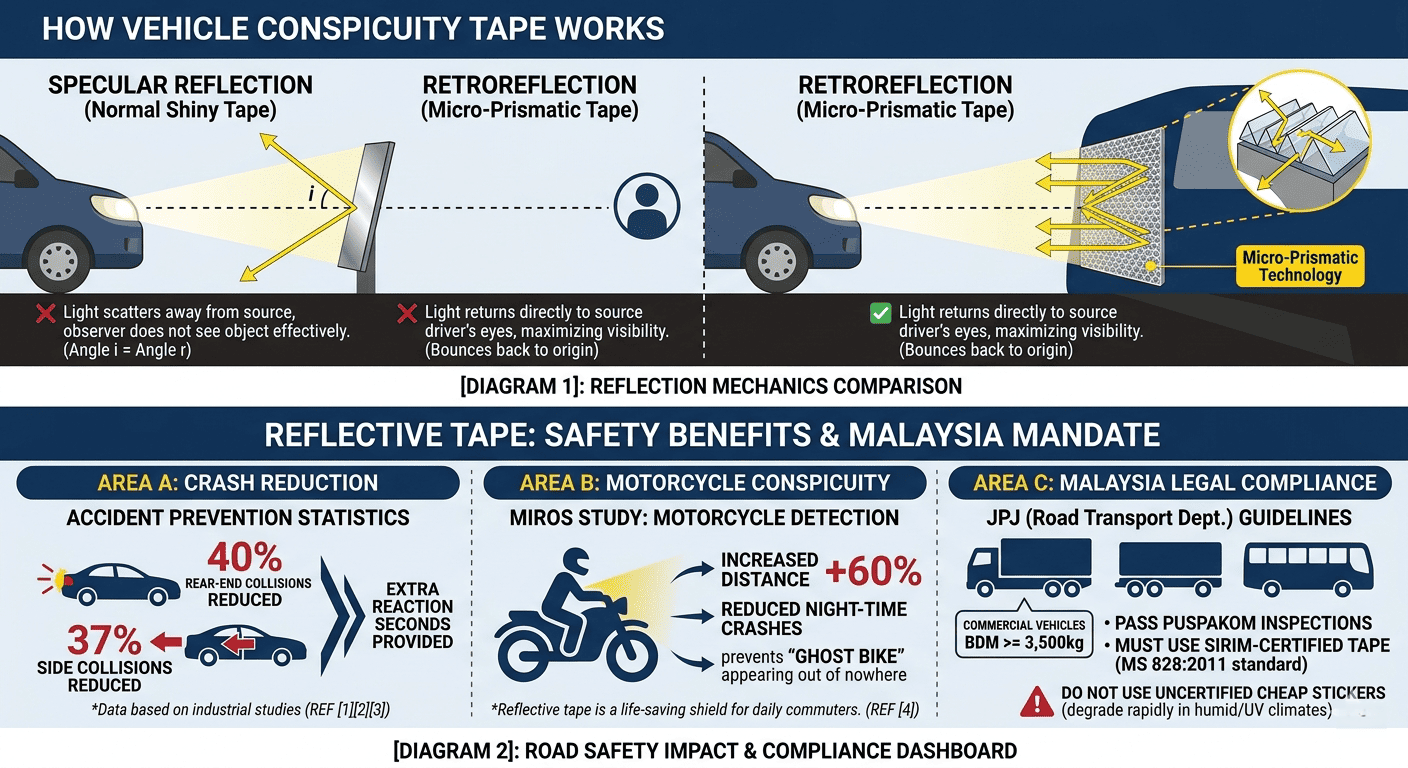
Many countries and regions worldwide strictly enforce the use of reflective markings on commercial fleets, heavy transport trucks, and emergency vehicles to satisfy national safety standards (such as the United States' DOT-C2 or Europe’s ECE 104 certifications). Utilizing compliant reflective tape ensures that vehicles adhere to legal mandates for annual transportation inspections and roadworthiness approvals. Beyond baseline legal compliance, adopting these materials demonstrates a corporate commitment to public safety, helping fleet operators minimize accidents. According to transportation safety research, compliant markings help reduce rear-end collisions by approximately 41% and side collisions by about 37%.
While Malaysia does not impose a nationwide, specific legal mandate requiring retroreflective tape for standard private passenger cars, commercial vehicles—including transport trucks and trailers exceeding specific weight thresholds—must strictly comply with visibility standards established under the Road Transport Department Malaysia (JPJ or Jabatan Pengangkutan Jalan) guidelines.
4. Durability, Material Science, and Cost-Effectiveness
Modern conspicuity tapes are manufactured using a variety of base polymers, the most prevalent being acrylic, Polycarbonate (PC), Polyethylene Terephthalate (PET), and Polyvinyl Chloride (PVC). Premium-tier conspicuity tape is typically constructed from high-grade acrylic, which is uniquely capable of enduring harsh environmental stressors such as prolonged UV exposure, heavy rain, snow, and extreme ambient temperature shifts.
High-quality tapes are engineered to maintain their retroreflective brightness long-term without cracking, fading, or peeling prematurely; industrial regulations frequently mandate an outdoor operational lifespan of up to 10 years. Conversely, lower-tier sub-standard tapes with much shorter lifespans are common in the marketplace, requiring caution during purchasing. Global brands like 3M and Avery Dennison from the United States, alongside Oralite from Europe, utilize top-tier acrylic formulations. Cost-effective alternatives, such as Toptend from China, also offer reliable acrylic lines. Tapes made from cheaper alternative plastics often compromise outdoor durability, lasting anywhere from a few months to just a couple of years. While high-grade acrylic marking tape requires a higher upfront cost, its long-term performance and the elimination of frequent replacement cycles make it highly cost-effective.
In Malaysia, a strict legal mandate (the MS 828:2011 standard) requires all commercial transport vehicles with a Gross Vehicle Weight (BDM) of 3,500 kg and above to pass mandatory PUSPAKOM vehicle inspections utilizing SIRIM-certified retroreflective tape. Using uncertified, cheap, counterfeit stickers is highly discouraged, as inferior adhesives and materials rapidly degrade, peel, and lose reflectivity under hot, humid tropical climates and intense UV exposure.
When evaluating manufacturing technologies and retroreflective performance levels, micro-prismatic construction is vastly superior to traditional glass-bead options. For example, standard white glass-bead tape delivers a relatively low reflectivity level, ranging from a few units to a maximum of 100 cd/lux (candela per lux, the standard international measurement unit for retroreflection). In stark contrast, high-performance micro-prismatic tapes easily achieve reflectivity ratings from hundreds to well over 1,000 cd/lux, making them highly visible over vast distances.
Additionally, modern reflective tape is lightweight, simple to apply, and requires virtually no ongoing maintenance. Because it requires a relatively minimal investment, its overall affordability makes it a highly intelligent safety upgrade for both private vehicle owners and commercial logistics firms seeking to minimize risk without incurring high operational costs.
5. Versatile Multipurpose Applications Across Vehicle Types
Reflective tape applications extend far beyond commercial semi-trucks, trailers, and buses. It is increasingly utilized on motorcycles, bicycles, agricultural tractors, construction machinery, and personal protective equipment (PPE) such as high-visibility safety vests, sportswear, and outdoor travel gear.
Motorcyclists represent between 60% and 70% of total road fatalities across Southeast Asian nations, including Malaysia, Vietnam, and Thailand. Drivers in these regions frequently encounter the dangerous scenario of a poorly lit motorcycle appearing suddenly on dark, rain-slicked secondary roads. For this reason, applying high-visibility retroreflective tape is a vital life-saving practice rather than a cosmetic accessory for daily commuters and the local motorcycle subculture ("Mat Moto").
An empirical field study conducted by the Malaysian Institute of Road Safety Research (MIROS) demonstrated that applying retroreflective conspicuity markings to motorcycles increased their nighttime detection distance by approximately 60% compared to baseline un-marked conditions (Khalid et al., 2020). Implementing retroreflective markings on motorcycles provides oncoming drivers with expanded visual reaction times, directly reducing nighttime accidents and preserving lives.
In rural or agricultural sectors where public street lighting infrastructure may be limited or unreliable, applying reflective tape to alternative transport vehicles like electric tricycles, utility carts, and farm machinery is highly practical. It delivers a proven boost to night safety. Similarly, emergency response vehicles rely heavily on specialized high-visibility reflective chevron striping to ensure instant visual identification during urgent roadside rescue operations.
6. The Functional Distinction Between "Shiny" Tape and Retroreflective Tape
Standard "shiny" tapes, typically fabricated from metallic or high-gloss plastic films, operate via specular reflection. When light strikes these glossy surfaces, it bounces off at a reflection angle equal to its entry angle, scattering the light in various directions away from the original source. Unless an observer happens to be positioned directly within the path of that scattered, angled beam, the tape appears dark or completely invisible. In a real-world driving environment, this scattered light rarely reaches a trailing driver’s eyes, offering negligible visibility benefits.
Conversely, authentic retroreflective tape utilizes precise micro-prismatic or micro-bead matrices designed to capture incoming light beams and return them directly back toward the originating light source (the vehicle's headlights and, by extension, the driver's eyes). This directed retroreflection maximizes luminance, ensuring that target vehicles remain highly visible from extended distances, even through heavy precipitation.
7. Weather Challenges in ASEAN Climates and the Role of Reflective Tape
Throughout Southeast Asia, atmospheric visibility impairments present severe road hazards. In major metropolitan areas like Kuala Lumpur, Jakarta, and Manila, high equatorial temperatures and elevated humidity often trigger sudden, violent, and heavy rainstorms, particularly during seasonal afternoon and evening monsoon shifts. As evening temperatures drop, heavy downpours rapidly obscure road surfaces, dramatically scattering and weakening the illumination cast by traditional vehicle headlights. Many serious collisions happen when drivers misjudge distance or fail to recognize the silhouettes of stationary transport trucks or pedestrians in the road ahead.
Under extreme conditions, visual range can fall to near-zero due to torrential downpours combined with heavy road spray, humidity, and seasonal haze pollution. High-quality reflective tape is uniquely effective in these scenarios because its retroreflective properties slice through ambient scattering. Even though the tape is passive and does not emit light independently, it introduces an extreme visual contrast element against dark backgrounds, improving vehicle conspicuity over longer ranges during downpours. In summary, while torrential evening storms degrade infrastructure visibility, pre-installed high-grade reflective tape maintains clear target recognition under low-light, wet conditions, acting as an invaluable complement to defensive driving practices.
Conclusion
In conclusion, high-visibility retroreflective tape stands as a simple, highly reliable, and exceptionally effective solution for elevating vehicle and road safety. By delivering elevated low-light visibility, driving down rear-end collision rates, ensuring compliance with transport regulations, and offering robust outdoor durability, it remains a pillar of modern international traffic safety initiatives. Drivers and commercial fleet operators are strongly encouraged to select and properly install certified, high-grade reflective tape to safeguard themselves and the motoring public. Beyond passive reflective markings, full compliance with comprehensive regional regulations—such as adherence to posted speed limits, mandatory seatbelt and helmet use, and strict blood alcohol concentration (BAC) legal limits—remains critical to ensuring overall road safety.
References
3M Commercial & Specialty Vehicles. (2021). The Ultimate Guide for Vehicle Visibility: 3M™ Conspicuity Markings for Trucks, Trailers, and Fleet Vehicles. 3M Road Safety Department. https://www.3m.com/3M/en_US/commercial-specialty-vehicles-us/applications/vehicle-visibility/
National Highway Traffic Safety Administration (NHTSA). (2001). The Effectiveness of Retroreflective Tape on Heavy Trailers (DOT HS 809 222). U.S. Department of Transportation.
Truck Home Media & 3M China. (2018). Safeguarding Your Journey: How High-Visibility Retroreflective Sheeting and Advanced Edge-Sealing Protect Commercial Fleets from Nighttime Collisions. Truck Home Technical Review Guidelines; compliance standards for GB7258-2017 specifications.
Khalid, M. S. A., Isa, M. H. M., Hamzah, A., Solah, M. S., Ariffin, A. H., Paiman, N. F., Jawi, Z. M., Ghani, M. R. A., Kassim, K. A. A., & Ishak, S. Z. (2020). The Effects of Retroreflective Conspicuity Tape on Motorcycle Detection Distance among Car Drivers. Journal of the Malaysian Institute of Road Safety Research (MIROS), 1(1), 12–19.
About the Author
Anna Zhang possesses over 15 years of industrial experience in reflective materials and traffic safety, with extensive expertise in reflective sheeting material as applied in traffic safety industry.
Edited by: Ch. Mahmood Anwar (PhD)
Do comment if you find this article interesting.